UDP-7777 is a high-availability, low-overhead paging system. It sends short text messages over UDP port 7777.
It is designed for LANs, VPNs (Tailscale, WireGuard, ZeroTier, etc), and localhost loopback.
The system is intentionally raw. No headers, no JSON, no XML.
Transport: UDP Port 7777
Encoding: UTF-8 Plain Text
Format:[SECRET::]MESSAGE
2. Interface Guide
RX (RECEIVER)
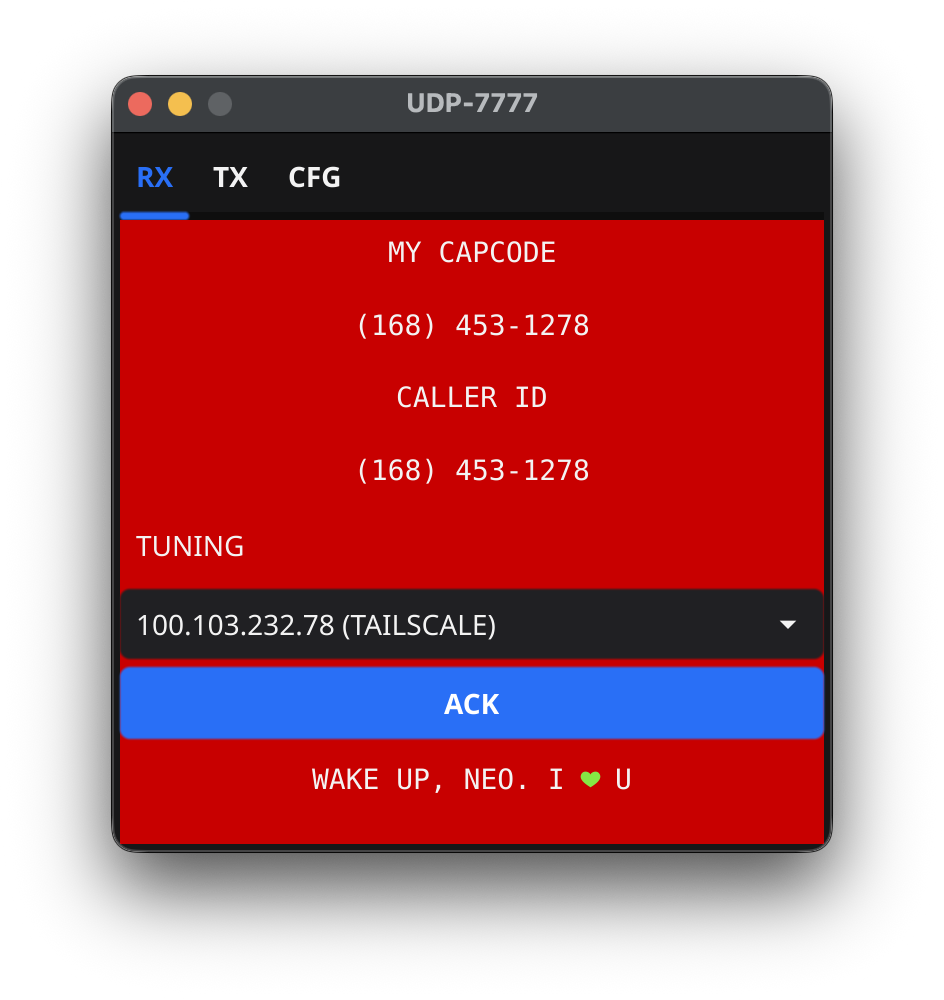
This is your listening station. When a signal is received, the window flashes red and a system beep sounds every 3 seconds until ACK.
[FIG 2.1: INCOMING SIGNAL ALERT]
MY CAPCODE: Your address. It is derived from your IP address.
Note: If running on a server with a static public IP (e.g., VPS), you can give out that public IP as your Capcode. Ensure UDP port 7777 is open/forwarded.
TUNING: Select which network interface to listen on.
Tip: Select "0.0.0.0" to listen on ALL interfaces (LAN, VPN, etc).
ACK: Acknowledge an incoming signal. Stops the blinking and sound.
TX (TRANSMITTER)
Send signals to other operators.
CAPCODE: Enter the target's IP address OR their 10-digit Phone Number style capcode.
PAYLOAD: The text message. Max ~1000 chars. Keep it brief.
CFG (CONFIG)
ENABLE SQUELCH: Filters out noise/spam. Only messages matching your Secret Key will ring.
SHARED SECRET: A password shared between you and the sender. Must match exactly on both ends.
3. CLI Operations (The Hacker Way)
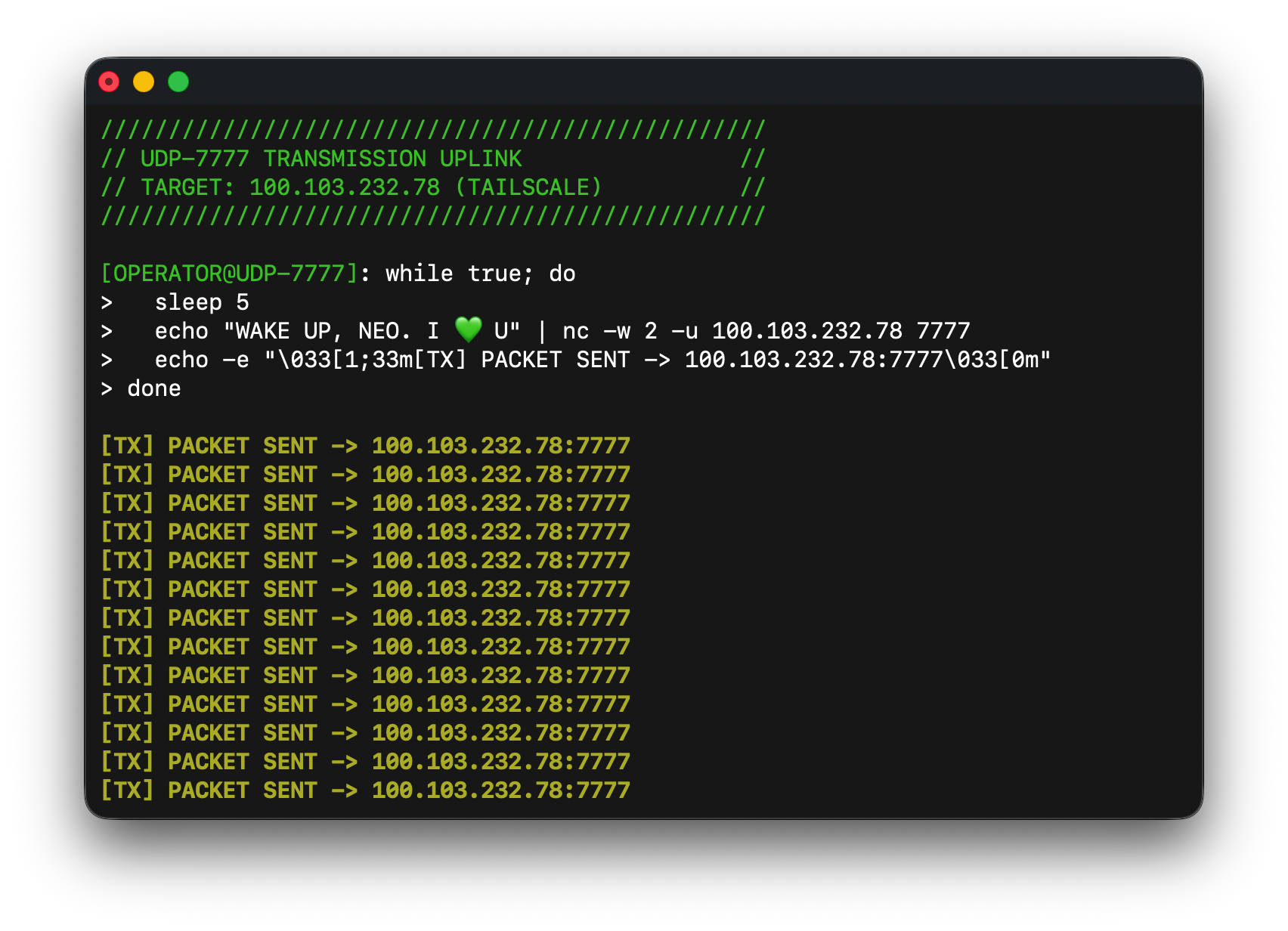
You don't need the app to SEND a signal. You can use standard unix tools like netcat (nc).
[FIG 3.1: MANUAL TRANSMISSION VIA NC]
# SYNTAX: echo "MESSAGE" | nc -u TARGET_IP 7777# Example 1: Page yourself (Loopback)
echo "WAKE UP NEO" | nc -w 1 -u 127.0.0.1 7777
# Example 2: Page a friend on Tailscale/LAN
echo "LUNCH TIME" | nc -w 1 -u 100.64.0.5 7777
# Example 3: The "Annoy-o-Tron" Loop
while true; do
echo "PING" | nc -w 1 -u 192.168.1.50 7777
sleep 5
done
Note: If the receiver has SQUELCH enabled, you must prefix your message with the secret:
# If secret is "hunter2"
echo "hunter2::THE PAYLOAD" | nc -w 1 -u 127.0.0.1 7777
4. The Capcode Protocol
To make IP addresses more memorable (like old pager numbers!), UDP-7777 converts IPv4 addresses into a 10-digit phone number format. This is purely a UI convenience; on the wire, it's still raw IP.
IP ADDRESS
CAPCODE (PHONE)
CONTEXT
127.0.0.1
(213) 070-6433
Loopback (Local)
192.168.1.101
(323) 223-5877
Home LAN
192.168.0.1
(323) 223-5521
Classic Router
10.0.0.5
(016) 777-2165
Private Network
100.64.0.1
(168) 191-5905
Tailscale / CGNAT
8.8.8.8
(013) 474-4072
Google DNS
1.1.1.1
(001) 684-3009
Cloudflare
IP to Capcode (Phone Number)
An IPv4 address (e.g., 192.168.1.101) is treated as a 32-bit unsigned integer, then formatted.
func ipToPhoneNumber(ip net.IP) string {
if ip == nil { return "UNKNOWN" }
v4 := ip.To4()
if v4 != nil {
ip = v4
} else {
if len(ip) >= 4 {
ip = ip[len(ip)-4:] // Use last 4 bytes for IPv6 fallback
}
}
val := binary.BigEndian.Uint32(ip)
str := fmt.Sprintf("%010d", val)
return fmt.Sprintf("(%s) %s-%s", str[0:3], str[3:6], str[6:])
}
Capcode (Phone Number) to IP
The 10-digit number is parsed back into a 32-bit integer, then converted to an IPv4 address.
func resolveTarget(input string) string {
if net.ParseIP(input) != nil { return input }
var digits string
for _, c := range input {
if c >= '0' && c <= '9' { digits += string(c) }
}
if len(digits) == 0 { return "" }
var val uint32
fmt.Sscanf(digits, "%d", &val)
ipBytes := make(net.IP, 4)
binary.BigEndian.PutUint32(ipBytes, val)
return ipBytes.String()
}
5. Troubleshooting
No Signal? Check your Firewall. Allow UDP Port 7777 (Inbound/Outbound).
Wrong Capcode? Ensure you selected the correct Interface in the RX tab (e.g., Tailscale vs WiFi).
Windows? You may need to click "Allow Access" on the Windows Firewall popup on first launch.
Windows Server / RDP? If the app doesn't open (blank window or silent exit), the server lacks OpenGL drivers.
Fix: Download the latest mesa3d-release-msvc.7z from pal1000/mesa-dist-win.
Extract ALL DLL files from the archive into the same folder as udp7777.exe.
4v6? We only do IPv4 right now. They make the most sense to display in "dialup" format.